
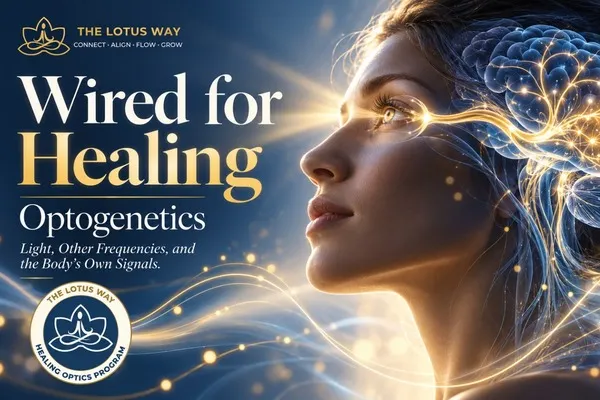
Wired for Healing
Wired for Healing
Optogenetics: Light, Other Frequencies, and the Body's Own Signals
What if one of the most important lessons of the 2026 Nobel Prize in Medicine isn't about the technology scientists invented, but about the extraordinary capabilities already present within our bodies?
After decades of groundbreaking research, scientists have learned to control nerve cells with light. An extraordinary achievement.
But what if the most fascinating part of this discovery isn't what scientists have engineered into cells, but what our bodies already know how to do?
For generations, healing traditions have worked with light, movement, breath, touch, and the body’s responses to its environment. Now, modern science is revealing increasingly sophisticated mechanisms behind some of those responses.
And the implications extend far beyond the pharmaceutical and genetic technologies dominating the headlines.
A Nobel Prize for Teaching Cells to Respond to Light
In October 2026, Karl Deisseroth, Peter Hegemann, and Georg Nagel received the Nobel Prize in Physiology or Medicine for discoveries that made optogenetics possible.
The science is fascinating.
Researchers discovered a light-sensitive protein in a single-celled green alga. By introducing the gene for that protein into selected nerve cells, they made those cells responsive to precisely timed pulses of light.
Imagine being able to activate particular neurons with a flash of light. That’s essentially what optogenetics makes possible.
The technology has transformed neuroscience and opened promising possibilities for neurological and retinal conditions.
In 2021, researchers reported partial recovery of visual function in a man with advanced retinitis pigmentosa using optogenetic therapy and specialized light-stimulating goggles.
His lost photoreceptors had not regenerated. Instead, scientists found a new way to activate surviving retinal cells.
An extraordinary achievement. But consider what this discovery tells us about living tissue.
Cells can change their behavior in response to signals. And much of the machinery for receiving those signals is already there.
What If We Didn't Need to Introduce Anything New?
Optogenetics requires introducing genetic instructions that give selected cells new light-sensitive capabilities.
But our bodies already possess countless mechanisms for responding to the world around us.
Our eyes detect light. Our nerves conduct electrical signals. Our tissues respond to pressure and movement. Our cells constantly exchange chemical and electrical information.
And these signals do more than keep our hearts beating and muscles moving.
Research into bioelectricity and regenerative biology has shown that electrical signals help coordinate tissue growth, cellular behavior, and regeneration in certain experimental organisms.
Scientists are discovering that genes are only part of the story. The signals surrounding cells also help determine what those cells do.
That opens an entirely different set of possibilities. What might happen if we devoted comparable research resources to learning how to work with the body’s existing signaling systems?
We are already investigating some intriguing approaches:
Photobiomodulation: Red and near-infrared light can influence mitochondrial activity and cellular signalling, with emerging applications in retinal and other conditions.
Microcurrent: Small electrical currents are being studied for their potential effects on cellular signalling, tissue repair, and physiological regulation.
Mechanical stimulation: Research into mechanosensitive ion channels, including PIEZO1, reveals how cells translate physical forces into biological responses.
Terahertz stimulation: Experimental research suggests that certain electromagnetic frequencies can influence calcium signalling without introducing foreign genetic material.
Breathwork and meditation: These practices can influence autonomic regulation, stress physiology, and other functions through the body’s existing regulatory systems.
These approaches don’t duplicate optogenetics, and their clinical evidence varies considerably. But together, they illuminate something profound.
Living tissue isn’t passive. It responds, adapts, communicates, and, under the right conditions, repairs.
Ancient Observations Meet Modern Science
Long before anyone understood ion channels or mitochondria, practitioners of East Asian medicine, Ayurveda, yoga, and other healing traditions were exploring how the body responds to its environment.
They developed practices involving light, breath, movement, touch, nourishment, and awareness.
Their explanations arose from different philosophical traditions, and we shouldn’t pretend they were describing modern molecular biology. But their observations mattered then, and they matter now.
Modern science gives us powerful new ways to investigate some of those relationships.
The opportunity isn’t to replace ancient knowledge with scientific terminology, or to reject contemporary discoveries in favor of tradition. It’s to bring these ways of understanding the human experience into meaningful conversation. And to ask better questions.
Follow the Money. Then Follow the Questions.
Here’s where this story becomes particularly interesting.
Modern biomedical research requires enormous investment. Deloitte’s 2026 analysis estimated an average development cost of approximately $2.67 billion per new pharmaceutical asset among the major companies it studied.
Those investments are made with expectations of financial return. Patents, proprietary technologies, and market exclusivity help make that investment possible.
But what happens when an intervention is difficult to patent, inexpensive to reproduce, or something people can learn to practice themselves?
Who finances the large clinical trials? Who funds decades of investigation?
Commercial incentives are not the only factor shaping research, and nonpharmaceutical technologies can certainly be profitable. But financial opportunity influences which scientific questions attract sustained investment.
The absence of large clinical trials doesn’t necessarily mean an approach lacks value. Sometimes it means no one has found a sufficiently profitable reason to fund the research.
That should concern anyone interested in the future of medicine.
What discoveries might emerge if we invested as seriously in understanding the body’s existing capacities as we do in developing proprietary ways to intervene in them?
Why This Matters to Me
My work as an educator, yoga therapist, and practitioner of East Asian medicine has long been shaped by the body’s remarkable responsiveness.
For nearly 30 years, my mentors and I have observed meaningful improvements in health and visual function through our respective clinical practices. Some of the most compelling observations have involved people living with retinal and optic nerve conditions, including improvements accompanied by changes documented through ophthalmic testing.
In more recent years, these observations have continued through The Lotus Way, a 501(c)(3) nonprofit organization I direct, and its Healing Optics Program, where we provide education, resources, and community support for people exploring ways to support their health and visual well-being.
These experiences span decades of clinical practice and years of nonprofit education. They are not controlled clinical trials, and they cannot establish which interventions produced particular outcomes. But they represent a meaningful history of observation that deserves continued scientific investigation.
And they remind me that meaningful knowledge develops not only in laboratories, but also through careful observation, lived experience, and the willingness to explore what we don’t yet understand.
Perhaps It’s Time We Listened More Closely
The Nobel Prize celebrates an extraordinary scientific achievement: learning to communicate with selected nerve cells using light.
But perhaps its larger gift is the invitation to reconsider what living systems are already capable of.
What if the future of medicine includes not only increasingly sophisticated drugs and genetic technologies, but also a deeper understanding of how to support the body’s own communication and regulatory systems?
What if some of the most important discoveries are waiting not in the next proprietary product, but in biological pathways that deserve far more investigation?
We don’t have to reject modern medicine to ask these questions. We simply have to remain curious enough to follow the science beyond the products it creates.
We were wired for healing.
Perhaps it’s time we listened more closely.
Explore the Full Story
This blog introduces a few of the questions explored in my full article, Wired for Healing: Optogenetics, Light, Other Frequencies, and the Body’s Own Signals.
The complete article examines the Nobel discoveries, emerging research, traditional healing knowledge, and how commercial incentives shape the evidence available to us.
I invite you to read it, explore the references, and join the conversation.
Learn more about our educational and community programs at The Lotus Way, including Healing Optics, which offers education and support for people living with macular, retinal, and optic nerve conditions.
Program Note
The Healing Optics Program is an educational curriculum offered through The Lotus Way, a registered 501(c)(3) nonprofit organization. It is not a medical practice and does not constitute medical diagnosis or treatment. All content is intended to support informed decision-making in consultation with qualified healthcare providers.
Correspondence
Heather George, DSOM, L.Ac. Founder and Director, The Lotus Way | Healing
If you find this article useful, please share it with others who may need it. See QR code here for more or contact us online.
The Healing Optics Program (HOP), offered through The Lotus Way, a 501(c)(3) nonprofit organization, was built to bring that philosophy, the tools, and the evidence behind it, to people who deserve access to them.