
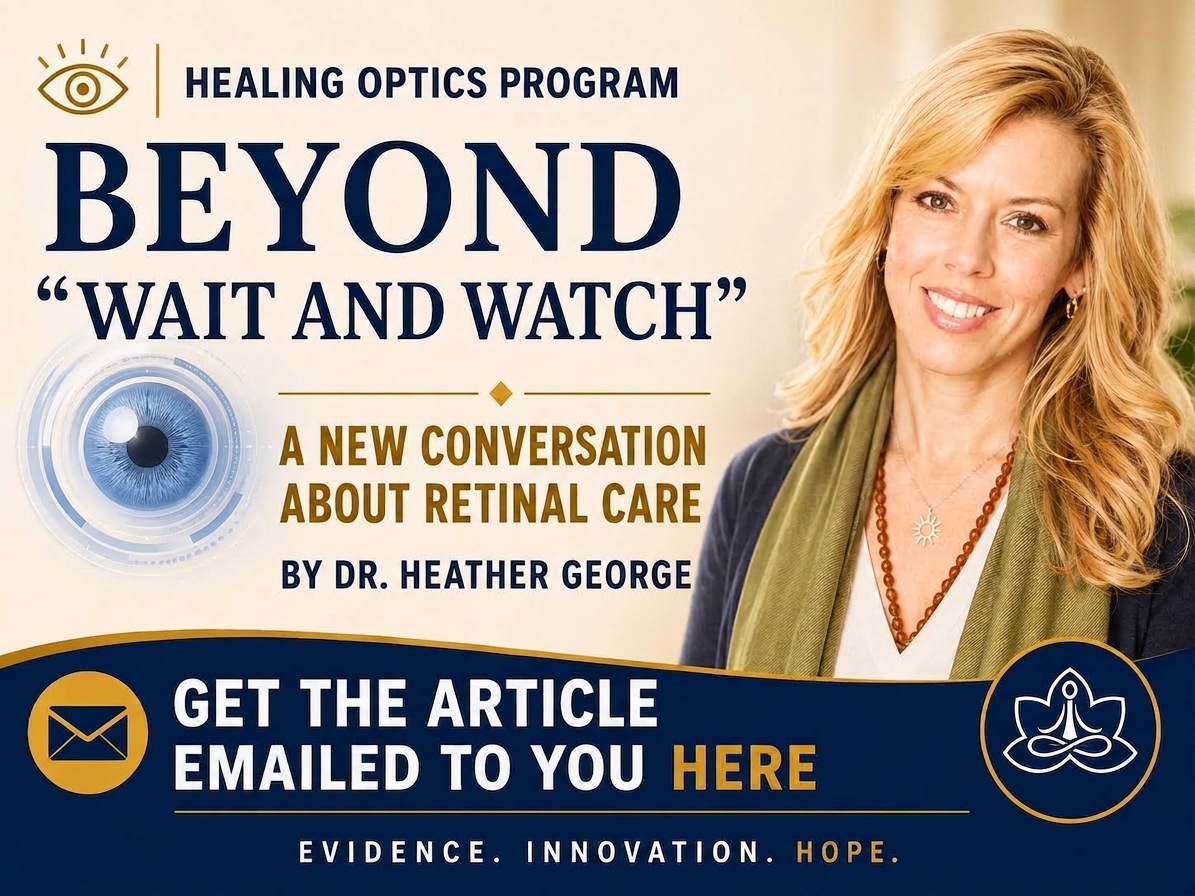
Beyond “Wait and Watch”
INTEGRATIVE VISION HEALTH | REGENERATIVE PERSPECTIVE
Beyond “Wait and Watch”:
Microcurrent Stimulation, Integrative Protocols for Retinal Disease
Abstract:
As someone who has worked closely with people living with macular degeneration, retinitis pigmentosa, Stargardt disease, and other retinal conditions, I have heard too many patients being told that there is little to do beyond “wait and watch,” periodic monitoring, or, in some cases, intravitreal injection therapy. I believe this perspective is too limited. It does not fully account for the historical and growing body of peer-reviewed evidence supporting microcurrent stimulation (MCS) as a safe, non-invasive, and clinically meaningful intervention for retinal disease.
In this article, I share key findings from the published literature, explore the mechanisms by which MCS is understood to support retinal cell function, and review the current regulatory and clinical landscape, including recent Canadian federal legislation and active clinical trials in the U.S., Australia, and New Zealand. I also describe the integrative protocol framework used within the Healing Optics Program (HOP).
My purpose is simple: to bring this information into the light. I believe the convergence of emerging evidence, decades of clinical observation, and growing institutional recognition represents a watershed moment. People living with retinal disease, and those who care for them, deserve access to this knowledge now — not years from now.
Introduction:
A Diagnosis That Does Not Have to Be a Dead End
Every day, people leave ophthalmology offices with a diagnosis and a directive: come back in six months, take your AREDS2 supplements, and hope you don’t degenerate too much more. For conditions like dry age-related macular degeneration (AMD), retinitis pigmentosa (RP), Stargardt, and other retinal conditions, this approach reflects the genuine limitations of the current conventional standard of care.
Similarly, those diagnosed with wet AMD are often told that injections are their only option. These standard protocols do not reflect the full scope of viable therapies available. My mentors and I have spent more than two decades working at the intersection between conventional ophthalmology and what else can be done. Following completion of my doctoral degree, my training included direct mentorship under Dr. Gene Bruno, founder of AcuDoctor.com and one of the most experienced integrative vision practitioners in the country, a pioneer in the use of microcurrent stimulation (MCS) applied to acupuncture points for retinal disease. He treated hundreds of people over 25 years and eventually entrusted his practice to my care. What I inherited was not simply a set of protocols.
It was a medical philosophy: that retinal tissue is not as inert as we have been led to believe, that the body has meaningful capacity for repair when given the right tools, and that the research has been pointing in this direction for decades. For the most part, this knowledge (and the studies supporting it) rarely made it into the exam room in the U.S. and many other countries. Yet these therapies have been embraced and used by integrative practitioners with significant and consistent results for 30 years.
The Mechanism:
Why Microcurrent Stimulation Makes Biological Sense
Microcurrent stimulation involves the application of extremely low-level electrical currents, measured in microamperes, to tissue. At the appropriate parameters, this stimulation has been shown to increase intracellular adenosine triphosphate (ATP) concentrations, enhance protein synthesis, and improve cellular membrane transport. These are not theoretical effects. They are documented in peer-reviewed literature. Multiple lines of research consistently demonstrate that electrical stimulation produces its greatest therapeutic benefit when parameters are individually calibrated to the patient.
A systematic review published in a peer-reviewed neuromodulation journal found that individualised calibration to the patient’s electrical phosphene threshold produced the most reliable improvements in visual acuity, visual field, and retinal function across conditions including RP, AMD, and optic neuropathy. This body of evidence underscores why device selection, parameter settings, electrode placement, and professional guidance are not interchangeable details. They are clinically significant variables that determine outcomes. The relevance to retinal disease lies in the role of mitochondrial function in photoreceptor and retinal pigment epithelium (RPE) cell health.
Research has demonstrated age-related decline in mitochondrial ATP synthase activity in retinal tissue. A genetic defect in the ATPase 6 gene has been implicated in retinitis pigmentosa. ATP dysfunction appears to be a common thread across multiple genetically related forms of retinal degeneration, including AMD, Stargardt disease, RP, and other retinal conditions. If impaired mitochondrial energy production underlies the progressive cell death seen in these conditions, then a therapy shown to restore ATP concentrations represents a physiologically coherent intervention, not an alternative treatment, but a targeted one. Applied directly over the orbit and to acupuncture points surrounding the orbit, microcurrent reaches the retina through pathways of lower electrical resistance.
Points including those at the supraorbital and infraorbital foramina, long used in classical Oriental medicine to support ocular health, serve as conduits for delivering therapeutic current to the posterior segment of the eye. This integration of classical acupuncture point theory with bioelectrical medicine reflects centuries of practice and theory, and decades of clinical refinement.
What the Evidence Shows
The published literature on microcurrent stimulation for retinal disease is more extensive than most clinicians realize, with significant contributions from Germany, Russia, and other parts of the former Soviet Union, where electrostimulation has long been integrated into ophthalmic practice, and now embraced by researchers and practitioners in Canada, the U.S., Australia, New Zealand, and beyond.
Several findings stand out:
A landmark study combining microcurrent stimulation with nutritional supplementation followed dry AMD patients over two to seven years. The MCS group lost an average of 0.30 letters of visual acuity. A comparable cohort receiving nutritional supplementation alone lost 4.1 letters over just two years. A placebo group lost 7.1 letters. The separation between these groups is not subtle.
A 2015 peer-reviewed study published in Clinical Ophthalmology reported that 52% of dry AMD patients showed significant improvement in visual acuity following MCS therapy. Among wet AMD patients in the same study, 83% showed improvement, although the smaller sample size in that subgroup limited statistical significance.
Edward L Paul, Jr, O.D., PhD, visiting Professor of Ophthalmology and Chairman of Continuing Medical Education at St. Luke’s University School of Medicine published results from 94 eyes treated with an integrated MCS and nutritional supplementation protocol between 2001 and 2002. Overall, 68% showed marked improvement in visual acuity. The success rate was 72% in AMD, 83% in Stargardt disease, and 53% in retinitis pigmentosa. Average improvement was two to three lines on the Snellen chart. Dr. Paul also cited the American Academy of Ophthalmology’s own assessment that the overall rate of adverse effects from electrical stimulation appears to be low, a notable acknowledgment from a conventionally conservative institution.
Researchers at the Polenov Russian Neurosurgical Institute in Saint-Petersburg treated 446 patients with optic nerve lesions using noninvasive transorbital alternating current stimulation, finding significant improvements in visual field size in both eyes, with the strongest results in patients with vascular-origin optic nerve damage showing visual field improvements exceeding 13%. This large-scale Russian observational study was among the foundational works that informed subsequent clinical trial development internationally.
A prospective, double-blind, randomized, placebo-controlled clinical trial conducted at the University of Magdeburg, Germany demonstrated that noninvasive transorbital alternating current stimulation produced a 69% improvement in visual field detection deficit in optic neuropathy patients, with EEG changes indicating increased neurological synchronization in posterior brain regions. This German research directly informed the design of the clinical trials now entering conventional medicine in the U.S. and internationally.
A randomized, sham-controlled trial published in Investigative Ophthalmology and Visual Science demonstrated significant improvements in visual acuity, contrast sensitivity, and visual field performance in optic neuropathy patients receiving alternating current stimulation. Benefits persisted for at least two months following the treatment period.
A systematic review published in a peer-reviewed ophthalmic journal examined electrostimulation across multiple retinal conditions namely AMD, retinitis pigmentosa, glaucoma, retinal vein occlusion, and optic neuropathy. The review found consistent evidence supporting the use of electrostimulation as a meaningful intervention for preserving retinal function.
Observational data compiled from early pioneering clinical work in this field documented results across 120 patients with AMD, RP, Stargardt disease, and x-linked retinoschisis, outcomes which directly shaped the development of HOP. Between 85 and 91 percent showed significant improvement in visual acuity. Many subjects gained four or more lines on a standard eye chart. These are conditions for which conventional medicine has no comparable efficacy data.
This body of evidence does not represent fringe science, it represents a decades-long record of peer-reviewed clinical observations that have not yet been integrated into standard of care treatment, in large part because the therapies involved do not generate pharmaceutical revenue. Unfortunately, clinical trials sufficient to move institutional guidelines require funding that rarely materializes from non-patentable interventions.
Institutional Recognition: The Regulatory Landscape is Shifting
The past two years have brought a pace of institutional recognition that stands in sharp contrast to the decades of slow uptake that preceded them. What was once emerging research is now moving into approved clinical use, and what was limited to Canada is now expanding across continents. In June 2023, Canada’s Parliament passed Bill C-284: The National Strategy for Eye Care Act (www.parl.ca/DocumentViewer/en/44-1/bill/C-284/royal-assent), the first national legislation to formally include non-invasive, technology-driven vision support within a public health strategy.
The legislation specifically supports low-vision assistive technologies aimed at preserving function and independence. In September 2025, Health Canada granted full approval to MacuMira as the first approved treatment to improve visual function for patients with dry AMD, now available in clinics across Canada and expanding internationally. In April 2026, the FDA granted Investigational Device Exemption approval for the i-SIGHT2 Pivotal Study, now enrolling participants across four countries including the U.S., Australia, and New Zealand.
Notably, both MacuMira and i-SIGHT2 deliver stimulation transpalpebally through closed eyelids, the same fundamental pathway that periorbital microcurrent protocols have employed for decades. The regulatory recognition of this approach validates a body of work that integrative practitioners have built and refined long before it entered the institutional mainstream.
HOP is designed to complement those options, providing the integrative educational foundation, home-based continuity, and comprehensive support that periodic in-clinic sessions alone cannot offer. For the many people who cannot yet access or afford in-clinic treatments, and for those who simply want more than an in-clinic session can provide, HOP fills a gap that institutional medicine was never designed to fill, and will still not fill in future years even once options are integrated into conventional clinical settings.
Why Protocol Precision and Integrative Support are Non-Negotiable
The published evidence consistently demonstrates that the outcomes documented in MCS research, including improvement rates of 83% or more and gains of four or more lines on a standard eye chart, were achieved under professional protocols using appropriate instrumentation, with parameters individually calibrated to each patient. Device selection, parameter settings, electrode placement, session duration, and treatment frequency are all clinically significant variables. These are not details that a person can optimize independently without guidance. As well as integrating with adjunct therapies like targeted nutrition, acupressure, photobiomodulation and light therapy, and nervous system regulation, all of which are covered in HOP’s educational program.
There are dozens of microcurrent devices marketed to consumers. These devices vary widely in output parameters, electrode configuration, and design intent. Some are appropriate for this work, others are not. Using the wrong device, at the wrong settings, on the wrong points, will not produce the outcomes documented in the research. In some cases, it may cause harm. The research results that compel attention were achieved under professional protocols with appropriate instrumentation, and set in the context of a comprehensive integrative approach. Integrative context matters as much as the device utilized. Studies consistently combine MCS with nutritional supplementation for good reason. ATP production depends on mitochondrial substrate availability.
Nutrients such as lutein, zeaxanthin, DHA, taurine, and other targeted antioxidants are not adjuncts; they are part of the mechanism. Acupressure and classical East Asian medicine practices support retinal circulation through pathways that predate and complement the bioelectrical model. Photobiomodulation and light therapy offer additional adjunct support for retinal cellular health.
Nervous system regulation affects vascular tone and therefore retinal perfusion. These elements work synergistically together. Isolating any one of them produces inferior results. Individualizing based on each person’s needs and supporting holistic integration helps optimize outcomes. This is the evidence-based rationale for a program rather than a product. It is also what I have witnessed over years of direct patient care, as I embraced the advancing technology for online and remote support, greatly reducing the need for in-person support and increasing our ability to support more people in a more accessible and affordable way.
The Healing Optics Program:
A Structured Response to an Unmet Need
The Healing Optics Program (HOP) was developed to make an integrative, educational, home-based approach and it is available to people that cannot access specialized clinical care. Whether because of geography, cost, mobility, or the simple fact that very few practitioners in the United States are trained in this line of work.
HOP is a comprehensive educational curriculum delivered through an online platform, offering weekly live practitioner support, an active member community, and direct access to trained regenerative vision specialists. Members also receive a professional-grade microcurrent device, utilized as part of the program’s guided educational protocols. Members receive structured instruction across more than 100 modules covering the science of their condition, research and resources for every modality we teach, applied acupressure protocols drawn from classical Oriental medicine, nutritional and supplementation information, research tools and resources on photobiomodulation and light therapy, nervous system regulation practices, and guidance in the use of specialized microcurrent equipment through professionally developed protocols. This is not simply a device tutorial.
The device is but one element of a comprehensive program designed to optimize decades of research and experience which have demonstrated meaningful outcomes in clinical and observational settings. HOP is an integrative, sustained, and community-centered approach applied with precision and professional oversight.
HOP is offered through The Lotus Way, a registered 501(c)(3) nonprofit organization. There are no individual profits from device sales. Supplementation guidance is evidence-based and not financially influenced by considerations of personal advantage. This structure exists to ensure that our primary focus is to produce outcomes for members.
Conclusion: The Evidence Exists. However, Access Remains the Question.
The question facing clinicians and people who encounter retinal disease is no longer whether microcurrent stimulation is an affordable, accessible, and evidence-based option, but why is it not being more robustly studied, supported, and made more widely available?
Published literature, current clinical trials, and recent legislation recognized in Canada make a strong case for this adjunct home-based therapy. The question is whether that evidence will translate into accessible, integrated, professionally guided care before more people lose their vision waiting for conventional healthcare systems to catch up.
I have had the privilege of witnessing in the active members of the Healing Optics Program, the answer to that question is urgent and practical. People do not have the luxury of time to wait for institutional consensus. People need access to safe, evidence-informed, professional tools and support right now. That is what we have created with HOP.
HOP is currently available as an educational model designed to give options for those who need it and help their patients with as an educational model designed to help optometrists, ophthalmologists, and retinal specialists, help their patients as an option for support, treatment and management. In my clinical experience, and even more so in the outcomes
We will continue to build on the success we have seen in our members as long as the conventional protocol is simply wait and watch, or injections as the only options. And even once the new in-clinic devices finally get integrated into conventional settings, HOP will still play a valuable role in the optimal care and support of people diagnosed with any degenerative retinal condition.
Selected References
Michael LD, Allen MJ. Nutritional supplementation, electrical stimulation and age-related macular degeneration. J Orthomol Med. 1993;8:168-171.
Paul EL Jr. The treatment of retinal diseases with microcurrent stimulation and nutritional supplementation. Presented to the International Society for Low-Vision Research and Rehabilitation; Goteborg University, Sweden.
Cheng N, et al. The effects of electric currents on ATP generation, protein synthesis, and membrane transport in rat skin. Clin Orthop Relat Res. 1982;171:264-271.
Shinoda K, et al. Microcurrent stimulation for dry and wet macular degeneration. Clin Ophthalmol. 2015.
Fedorov A, Jobke S, Bersnev V, Chibisova A, Chibisova Y, Gall C,
Sabel BA. Restoration of vision after optic nerve lesions with noninvasive transorbital alternating current stimulation: a clinical observational study. Brain Stimul. 2011;4(4):189-201. Sabel BA, Fedorov AB, Naue N, Borrmann A, Herrmann C, Gall C. Non-invasive alternating current stimulation improves vision in optic neuropathy. Restor Neurol Neurosci. 2011;29(6):493-505.
Schatz A, et al. Transcorneal electrical stimulation for patients with retinitis pigmentosa. Invest Ophthalmol Vis Sci. 2011.
Parkinson J, et al. Evaluation of visual acuity in dry AMD patients after microcurrent electrical stimulation. Int J Retina Vitreous. 2023.
Parliament of Canada. Bill C-284: National Strategy for Eye Care Act. Royal Assent, June 2023.
American Academy of Ophthalmology. Complementary Therapy Assessment: Microcurrent Stimulation Therapy for Macular Degeneration.
These developments are meaningful and worth celebrating. As clinic-based microcurrent options become available, they will serve an important role for those who can access them.
HOP is designed to complement those options, providing the integrative educational foundation, home-based continuity, and comprehensive support that periodic in-clinic sessions alone cannot offer. For the many people who cannot yet access or afford in-clinic treatments, and for those who simply want more than an in-clinic session can provide, HOP fills a gap that institutional medicine was never designed to fill, and will still not fill in future years even once options are integrated into conventional clinical settings.
Program Note
The Healing Optics Program is an educational curriculum offered through The Lotus Way, a registered 501(c)(3) nonprofit organization. It is not a medical practice and does not constitute medical diagnosis or treatment. All content is intended to support informed decision-making in consultation with qualified healthcare providers.
Correspondence
Heather George, DSOM, L.Ac. Founder and Director, The Lotus Way | Healing
If you find this article useful, please share it with others who may need it. See QR code here for more or contact us online.
The Healing Optics Program (HOP), offered through The Lotus Way, a 501(c)(3) nonprofit organization, was built to bring that philosophy, the tools, and the evidence behind it, to people who deserve access to them.